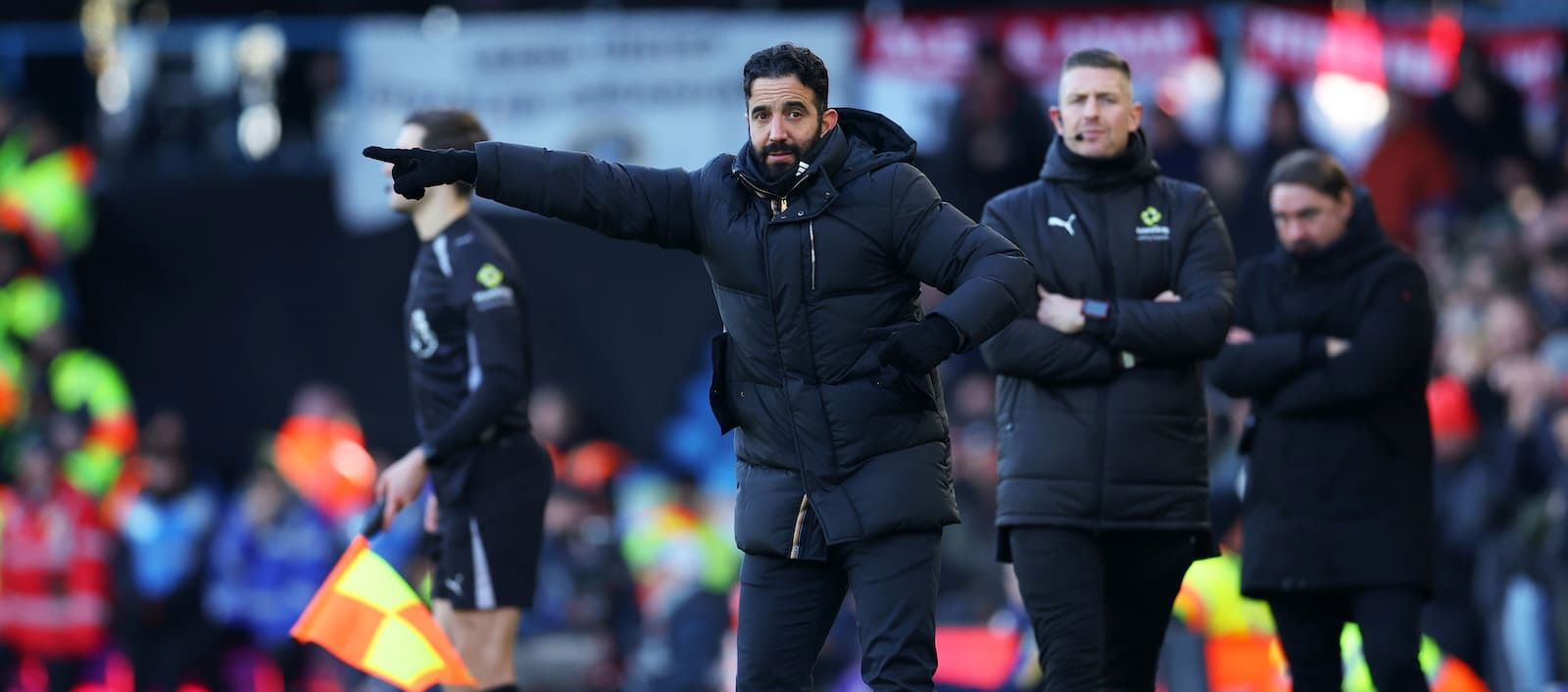
One definition of the Law of Unintended Consequences reads: “purposeful actions, especially interventions in complex systems, frequently yield unforeseen and unplanned effects”. Another example could be Ruben Amorim’s tumultuous tenure as Manchester United head coach.
Statistically, the Portuguese tactician’s reign is rough viewing, though the actual performances were even more of an eyesore. 14 months. 420 days. 63 games, resulting in 24 victories, 18 draws and an utterly 21 defeats – with a win percentage of just 31.9% in the Premier League. It is a record befitting a team embroiled in a relegation battle, as the Red Devils were for much of his debut season; at a member of ‘England’s elite’, it is indefensible.
Ruben Amorim managerial stats at Man United
| Played | Won | Drawn | Lost | Win % |
|---|---|---|---|---|
| 63 | 24 | 18 | 21 | 38 |
Yet, from the unrelenting barrage of pugnacious press conferences, stubborn systems, and drab displays of flawed football, five things have emerged that Amorim actually got right at Old Trafford – even if he did not mean to. Let’s dive in.
From Frozen Out To Flourishing
In a long line of inexplicable decisions, Amorim’s aversion to Kobbie Mainoo undoubtedly takes the pastel de nata. Considered one of the best young midfielders in Europe – both inside and outside the club – the 21-year-old England international was frozen out by Amorim, failing to start a single Premier League match under him last season.
Instead, Manuel Ugarte was often chosen, despite the 25-year-old having soundly proven to be the worst signing of the INEOS era. Crucially, Amorim believed his former enforcer at Sporting CP offered the requisite attributes out of possession that Mainoo was unable to replicate.
Within the context of his ill-fated 3-4-2-1 system, a midfielder was judged as much by their abilities without the ball as with it. The fact that Mainoo possesses more technical ability in his left pinkie than Ugarte does with both feet was irrelevant; the Uruguayan could run, and run, and…run.
Yet, eight months on from Amorim being axed by INEOS during the bleak midwinter at Old Trafford, Mainoo has re-established himself as an integral member of Michael Carrick’s side. A superb run of form, which helped United secure Champions League qualification, even earned the Stockport native an unlikely place in England’s World Cup squad, although Thomas Tuchel appeared to catch the same curious bout of anti-Mainooitis that had afflicted Amorim.
So what exactly did the prickly Portuguese get right, I hear you ask? Well, Mainoo undoubtedly became a better defensive midfielder during his exile.
Upon his return in January, he looked fitter, faster and far more formidable without the ball, displaying a discipline that had previously been missing from his game. His positioning was improved, his pressing more purposeful, and his awareness to track runners noticeably sharper. Amorim may never have intended it, but months spent on the margins forced Mainoo to confront the ‘deficiencies’ that had prevented him from trusting his prisoner in the first place.
United’s No.37 is a better player for the adversity he was subject to over the past year – and, for that, the fanbase must simply thank Amorim for getting it so gloriously wrong that he stumbled onto something right.
Square Peg, Round Hole
Next on the list of nonsensical choices was Amorim’s eureka moment to play Europe’s best attacking midfielder as a deep-lying playmaker, eschewing every piece of available evidence in favour of a dogmatic adherence to system; to formation over function.
Irrespective of the tattoo on his right arm, Bruno Fernandes is a No.10. He is a throwback to a time when football was played with instinct and individuality, rather than a game increasingly populated by identikit footballers drilled to think and play alike. A maverick in a world of marionettes.
Now, Amorim did not necessarily seek to change his captain; he simply played him in the wrong position. This transgression is not as unforgivable as with Mainoo, but it is equally misguided. Again, however, something oh so right emerged from something oh so wrong.
When Carrick restored Fernandes to his rightful throne as the team’s creator-in-chief, he produced the most scintillating form of his career, resulting in him breaking the Premier League’s all-time assist record. But is this not just evidence of why Amorim was a fool to have played him deeper? Well, yes and no.
Approaching his 32nd birthday next month, Fernandes is the best version of himself. He displays a maturity in possession that often escaped him in previous years in a red shirt. There is an awareness and appreciation of each part of the pitch, not solely the final third. He has grown as a leader as well, as concerned with his defence’s line as penetrating the opposition’s with an incisive through ball.
Put simply, spending the majority of Amorim’s tyrannical reign consigned to a double pivot in midfield has improved the Portugal international – mirroring the transformation Mainoo underwent.
If Kevin De Bruyne had been forced to play as a No.6 by Pep Guardiola during their time together at Manchester City, the Belgian would undoubtedly have emerged from the experience a better player.
Obviously, Guardiola would never have performed such a self-defeating experiment because, despite visual evidence to the contrary, he is not a mad scientist. But Carrick, his squad, and the Manchester United fanbase will benefit from Fernandes’ forced metamorphosis.
The maverick remains; he just has a more complete understanding of how to manage his minions now.
Banishing The Bad Boys
One of the pervasive issues which has plagued the Red Devils in the post-Sir Alex Ferguson malaise is poor attitude, on and off the pitch. To his credit, Amorim sensed this immediately, laying down the law to both Marcus Rashford and Alejandro Garnacho when the two forwards trained poorly as a message to the rest of the squad.
This eventually precipitated their departures: Rashford first, in January 2025, followed by Garnacho the following summer. Garnacho’s move to Chelsea for £40 million has proven an astute decision, given he fell off so far at Stamford Bridge the Blues shifted him to Aston Villa twelve months later.
By contrast, Rashford has made an unlikely return to the fold following FC Barcelona’s decision not to trigger the £26 million buy option in his loan deal. Carrick is supportive of his reintegration, no doubt happy to welcome back an experienced England international in a position the club wanted to make a signing this summer.
Whether the improvements Rashford has made over the past year in Spain – and with the Three Lions – stick remains to be seen; but it is without question he would not have made them had Amorim not forced him to. A fit and firing Rashford could prove an unexpected wildcard for United this summer.
However, the fact that neither he nor Garnacho had a natural ‘home’ in Amorim’s wingerless 3-4-2-1 system cannot be ignored. Had either been a tough-tackling midfielder, or a ball-playing centre-back, would their treatment by the former Sporting manager have been the same? If you believe so, I have a beachside property in Switzerland you might be interested in buying.
Putting United Back In Manchester United
One of the intended consequences of removing Rashford and Garnacho from the first team, as well as players like Jadon Sancho and Antony (two other wingers, surprise surprise), was to improve morale and unity in the dressing room. The feelgood factor was a notable feature of Amorim’s successful spell in Lisbon, having taken over the Portuguese club just over eighteen months after their fans stormed the training ground to angrily remonstrate with the players.
The Lions had not won a Liga Portugal title in two decades when he was appointed; they secured three titles in the next five years with his new and improved side. The fan anger was dispelled, replaced with fervent support and adulation of the man in the dugout.
While the same tale of success was not repeated in Manchester, two years on from INEOS’s decision to keep the unpopular, dour Dutchman, Erik ten Hag, as manager, United’s squad is a happy one. The clips that emerge from the club’s social media channels are curated, but there is an undoubted togetherness and camaraderie within Carrick’s group that cannot be manufactured.
Given Amorim often attacked his own squad in bombastic interviews during his time as head coach, even putting academy players in his crosshairs, he cannot be solely credited with this state of harmony. Yet his reign may have inadvertently helped create it. Shared adversity can forge unlikely bonds, and there are few things more unifying than collectively emerging from a miserable experience.
This is a harsh interpretation, however, as one of Amorim’s directives upon his appointment was to improve morale; it was definitely unintended, though, that Carrick would be the main beneficiary while he collected his P45 so soon after Christmas.
Focusing on Forwards
Last, but not least, on the list of unintended consequences Manchester United can thank their former dictator for is the arrival of Bryan Mbeumo and Matheus Cunha. Signed for a collective £133.5 million from Brentford and Wolverhampton Wanderers respectively, Amorim wanted the pair to jumpstart his misfiring attack. Having finished as two of the three top scorers – alongside fellow recruit Benjamin Sesko – this was a plan which bore fruit.
But as the Red Devils prepare for their season opener away to Hull City next weekend (22 August), neither Mbeumo nor Cunha will be playing in the position Amorim envisioned for them. Both were intended to be the No.10s in his unusual front three, flanking an imposing frontman.
Yet Carrick will almost certainly be using a 4-2-3-1, with Cunha out on the left and Mbeumo leading the line as a striker, given Sesko has yet to return from a shin injury. Even when the 6’5″ Slovenian is fit, however, Carrick may still opt for his more diminutive Cameroonian teammate, particularly if Amad shines on the right wing as he did for Ivory Coast at the World Cup.
It is not strictly a criticism of Amorim that two Premier League-proven forwards, capable of playing across a variety of roles in attack, have been deployed elsewhere by a different coach. But, and I’m sure you’re getting my drift now, it is yet another example of a decision which has engendered an effect different from the one the Portuguese had planned.
Final Thoughts
So, there it is. Five consequences Amorim produced without meaning to, that have inadvertently left Manchester United in a better state than he found it. Should he be praised for them? No. Should he instead be criticised? Yes. Should Kobbie Mainoo celebrate with a knee slide in front of him when scoring the winner against AC Milan – Amorim’s new side – later today? Absolutely. There is not necessarily a lesson in that, other than the night can be darkest before the dawn, although that is hardly an unforeseen and unplanned effect. Maybe this analogy was also the wrong decision.
Featured image Molly Darlington via Getty Images



1 comment
bruh , none of them cunha-mbuemo or sesko was amorim’s transfers, thats what yall said when he got the sack last season.